
BI Bench
A benchmark for AI data analysts on hard BI questions.
BI Bench is a benchmark we built at Basedash for AI data analysts. Every tool is connected to the same warehouse, asked the same set of difficult analysis questions, and graded against the same criteria. We publish each tool’s accuracy and response time at basedash.com/bi-bench, and the aggregated scores are on GitHub under CC BY 4.0.
We built it because, once we had an agent answering questions about customers’ data, we had to know whether each change to it made it better or worse. When I went looking for a standard way to evaluate an agent on real BI work, I didn’t find a good one. There were academic benchmarks for text-to-SQL, but they were dated, and models saturated them quickly.
Analysis work inside a company is hard in ways those benchmarks leave out. A real warehouse is messy. Data arrives from many sources, tables and columns are badly named, and the context that explains them is often missing. Several tables look like the right one when only one of them is. The questions are hard too: many take several queries that build on each other, with some reasoning about the results in between. A wrong join raises no error and returns a number that looks plausible.
I wanted a benchmark that was very difficult in all of those ways. I also wanted one we could run other products through, so that we could compare their harnesses with ours. And I thought people choosing a tool should have something better to go on than a scripted demo.
The environment is one production-grade warehouse with a large schema, and every tool sees all of it. We don’t hand over a curated subset of tables, because finding the right table among several plausible ones is part of what we are testing. The questions are the kind a data team gets from the rest of the company: multi-step, ambiguous, dependent on several joins, and easy to get almost right. I favor questions with a tempting wrong answer, because they separate tools that an easier question would score the same.
Each product runs the way a new team would first meet it, with its default model, reasoning effort, memory, context, and semantic layer behavior. Some tools would score higher with hand tuning. I chose defaults because they are what most teams experience first, and because I shouldn’t be the one deciding how well a competitor’s product gets tuned. We grade against a fixed set of criteria, applied the same way to every tool: whether the result is correct, whether the query used the right tables and joins, and whether the answer addresses what was asked. Accuracy is the share of those criteria a response meets, so a response earns credit for the parts it got right.
We record the response time for every task and publish it beside accuracy, because people work differently when answers come back quickly. When an answer arrives in twenty seconds, people ask a follow-up question. When it takes three minutes, an interactive analysis becomes a batch job and they stop asking. We publish the method and the scores, and keep the questions, the schema, the transcripts, and the rubric private, because a public question set measures less once tools have been tuned to it.
We wrote the benchmark and we compete on it, and I don’t expect anyone to overlook that. It is one warehouse and one set of questions, and each score is a snapshot of a product that keeps changing. We left out tools whose terms prohibit benchmarking and tools with no self-serve way to connect the same warehouse, so the list is incomplete. We re-run the benchmark as the tools change, and any vendor can ask us for a run or a re-run.
Results
The November 2026 snapshot covers eleven tools. Basedash was the most accurate at 95.8% and also the fastest, averaging 20.9 seconds per task. The next most accurate tool scored 90.9% and averaged 54.3 seconds.
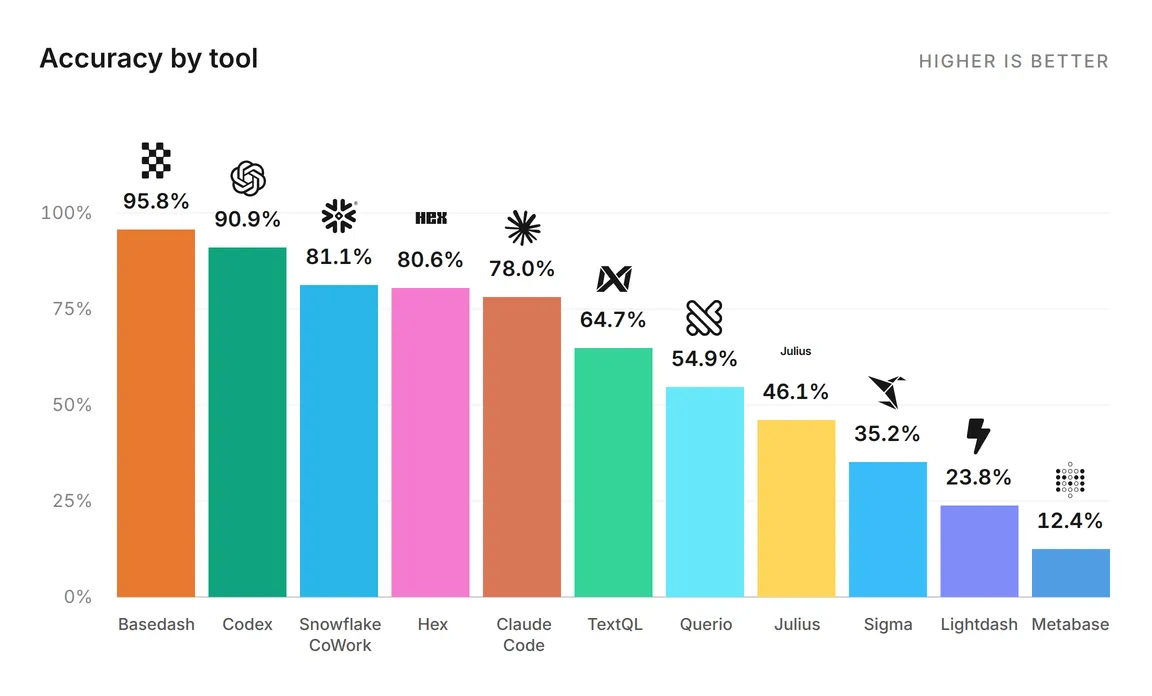
The spread is very wide: accuracy runs from 95.8% down to 12.4% on the same questions and the same schema. Speed and accuracy are also close to unrelated. The slowest tool in the run sits in the middle on accuracy, and the two general coding agents we tested, Codex and Claude Code, came second and fifth, ahead of most of the dedicated BI products.
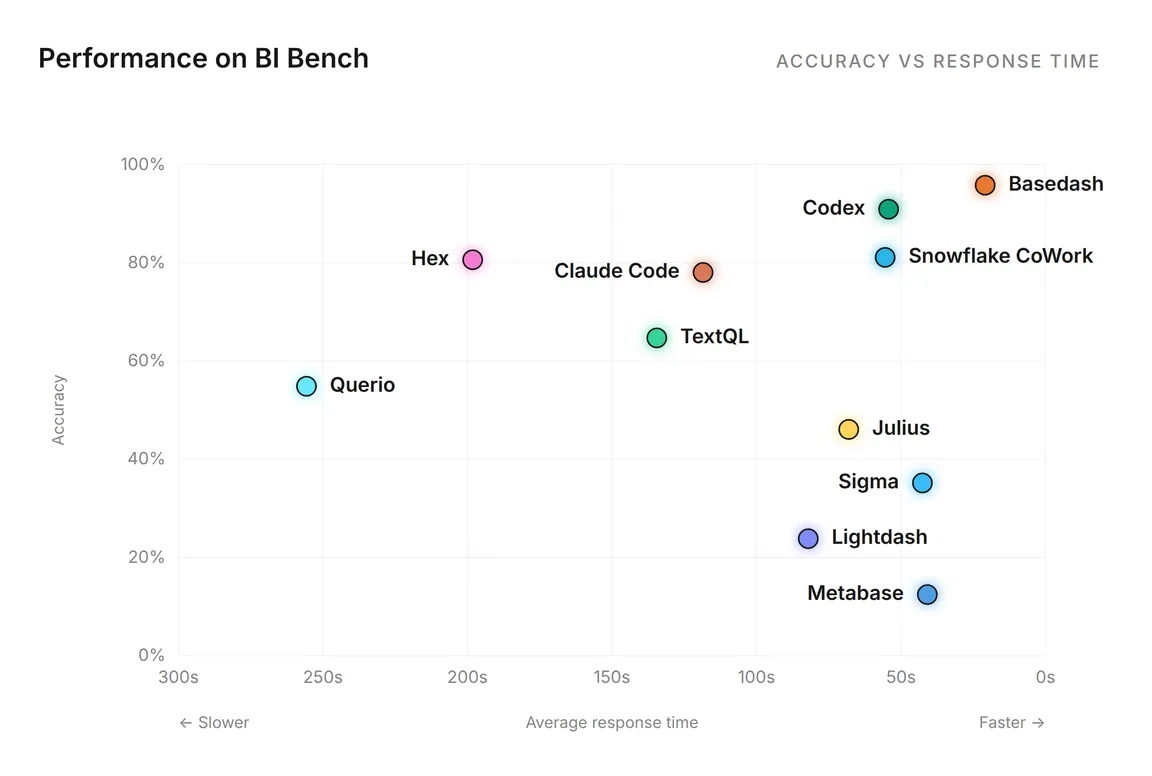
My reading is that a strong model is necessary, but that most of the remaining difference comes from the system built around it.
The harness
That system is usually called the harness, and a lot of our engineering goes into it. I think of a data analyst harness as about as complex as a coding agent harness, and companies have spent huge amounts of effort on those for Codex, Claude Code, and Cursor. Data analysis needs the same kind of engineering: careful tool design, searching a schema dynamically, and deciding when each piece of context reaches the agent.
I won’t describe ours in detail, but these are the problems it has to solve.
The first problem is context. A large schema doesn’t fit in a prompt, and an agent copes badly with a gap in what it knows. It guesses a table name, or it spends a series of slow queries rediscovering something we could have told it. The work is in deciding what the agent sees up front, what it can look up cheaply when it needs to, and how to tell it that something was left out. Table and column names are only part of it. Many wrong queries come from not knowing what a column contains, so the agent also needs a compact description of the data, labelled with how far it can be trusted. I wrote about how we do that in Teaching our AI agent what’s actually in your database.
The second problem is choosing a model. Basedash has never had a model picker. I think they are an anti-pattern. Given the choice, most people pick the biggest model, and then every question is slower, less efficient, and far more expensive than it needs to be. We built a router into the product that works out which model suits the question being asked. A slow model on an easy question costs time without adding accuracy, so the choice is a trade between accuracy, latency, and cost, and we revisit it with each new model release. We also use the advisor pattern, where a smaller model does the work and asks a bigger model for advice when it needs it. That lets the smaller model handle much more than it could alone. Anthropic describes the pattern in The advisor strategy.
The third problem is the cost of each step. An agent resends most of its context on every step, so the cost and latency of a long analysis depend on how much of each request the provider can serve from its cache. That in turn depends on details that look trivial, such as the order of the prompt and whether old tool output is trimmed the same way every time. We order each request from most stable to least, fetch rarely needed detail on demand instead of inlining it, and track the share of input tokens read from cache as a production metric. We learned this from a single timestamp that broke our prompt cache.
Some of this can be seen from outside, in BI Bench. We didn’t calculate what each tool’s run cost, because most of these products don’t expose their cost or their token counts. Response time is something we can measure for all of them, and I think it is a good proxy: an agent that uses fewer tokens tends to finish sooner, and token use drives the cost of inference. In the November snapshot the other ten tools took between about 2 and 12 times as long per task as Basedash. My read is that we are more token-efficient by a similar margin, though the benchmark doesn’t measure tokens directly.
The fourth problem is speed. In an agent loop, most of the wall-clock time goes to round trips: a call to the model, a tool call, a query against the customer’s warehouse, and back again. We try to cut the number of round trips. The agent looks things up in batches and in parallel, a lookup returns what the agent was about to ask for next, and exploratory queries stay off the customer’s warehouse when we already hold the answer.
None of this is safe to change without an eval that can detect the effect. Most harness changes are worth a few points of accuracy, which was less than our internal eval suite could resolve until we rebuilt its statistics around paired comparisons and a hierarchical bootstrap. I wrote about that in Our AI benchmark couldn’t detect a 7-point regression. That suite is separate from BI Bench, and we use it to decide whether a prompt change or a cheaper model ships.
The full results and the method are at basedash.com/bi-bench, and I wrote up the results in We benchmarked 11 AI data analysts on real BI questions in June 2026.