The end of the tech tree
Human technology can be modelled as an incredibly complex tech tree. We started with nothing, then slowly, throughout history, discovered new technologies like fire, language, currency, democracy, and computers.
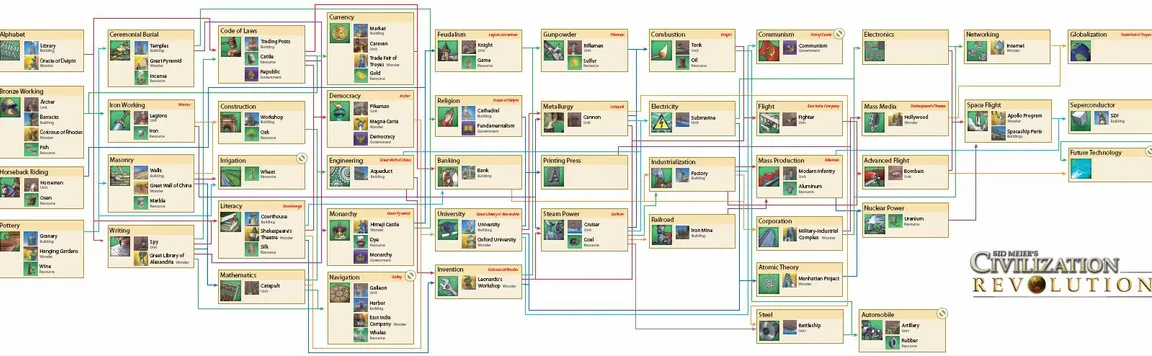
Each technology we discover unlocks a set of new technologies, like fire unlocking cooking, or clay unlocking pottery. But, it turns out the tech tree isn’t actually a tree (at least in the graph theory sense)—in some cases, there are multiple paths to a certain technology. Vehicles can be accessed via steam engines, jets, rockets, or electric motors, each of which has a very different path along the tech tree. In fact, any given technology could have hundreds of different paths, and each of those paths may have very different lengths. In an alternate timeline, we could have discovered warp drives before building cars, but that’s much less likely, since—according to our current understanding—warp drives are much deeper in the tech tree than combustion engines or electric motors.
However, unlocking one path to a technology often allows us to discover alternate paths in quick succession. Along the tech tree, steam engines take a very different path from electric motors, yet we discovered them only around 100 years apart. This is, in part, because unlocking a technology expands our minds and allows us to imagine technologies slightly beyond our current level. That’s why it’s so hard to write a sci-fi story that holds up longer than a few decades—anything that you can imagine today, however fantastical, is probably only a handful of nodes away on the tech tree. It would be almost impossible for an ancient Roman to imagine WiFi without first understanding electricity.
Over the past few decades, humanity has been diving incredibly deep into a few paths. One of those paths is AI. Just from a hardware standpoint, in the past century we’ve discovered transistors, integrated circuits, photolithography, microprocessors, lithium-ion batteries, GPUs, and thousands of other technologies in between. All this progress has led us to modern-day LLMs, which are now capable of complex reasoning.
But our progress along the tech tree might soon come to an end.
If progress along the AI path continues at a similar rate, we’ll have AGI within years, and superintelligence soon after that. That is, AI that is vastly smarter and more capable than humans at every cognitive task. If we’re somehow able to align and control this superintelligence, we’ll be able to progress along the tech tree at unprecedented rates. Imagine a million super-Einsteins, Oppenheimers, or von Neumanns simultaneously working to progress every path along the tech tree. It seems reasonable that they might just “complete” the tech tree.
What happens then? Society as we know it would end. Any technology that’s physically possible would be unlocked. Fusion reactors, warp drives, teleportation, superconductors, nanobots, you name it. But again, anything we can imagine today, however fantastical, is probably only a handful of nodes away. Anything actually far away on the tech tree is unimaginable and would probably feel like magic. We’d be the Romans trying to understand WiFi.
In the Civilization games, once you research all technology on the tree, there’s one more “Future Tech” node that you can keep researching over and over for points. Eventually, you reach the science victory condition and your ship leaves for Alpha Centauri, leading to your final victory.
As the player, you never see what happens next. This time, we will.